Keep it, sell it, or pass it down: which path fits your future?
Why Succession Planning Comes Down to Three Choices
Every business owner faces the same fundamental question sooner or later:
What happens when I’m no longer running the business?
That moment might come through retirement, a sale, or an unexpected life change.
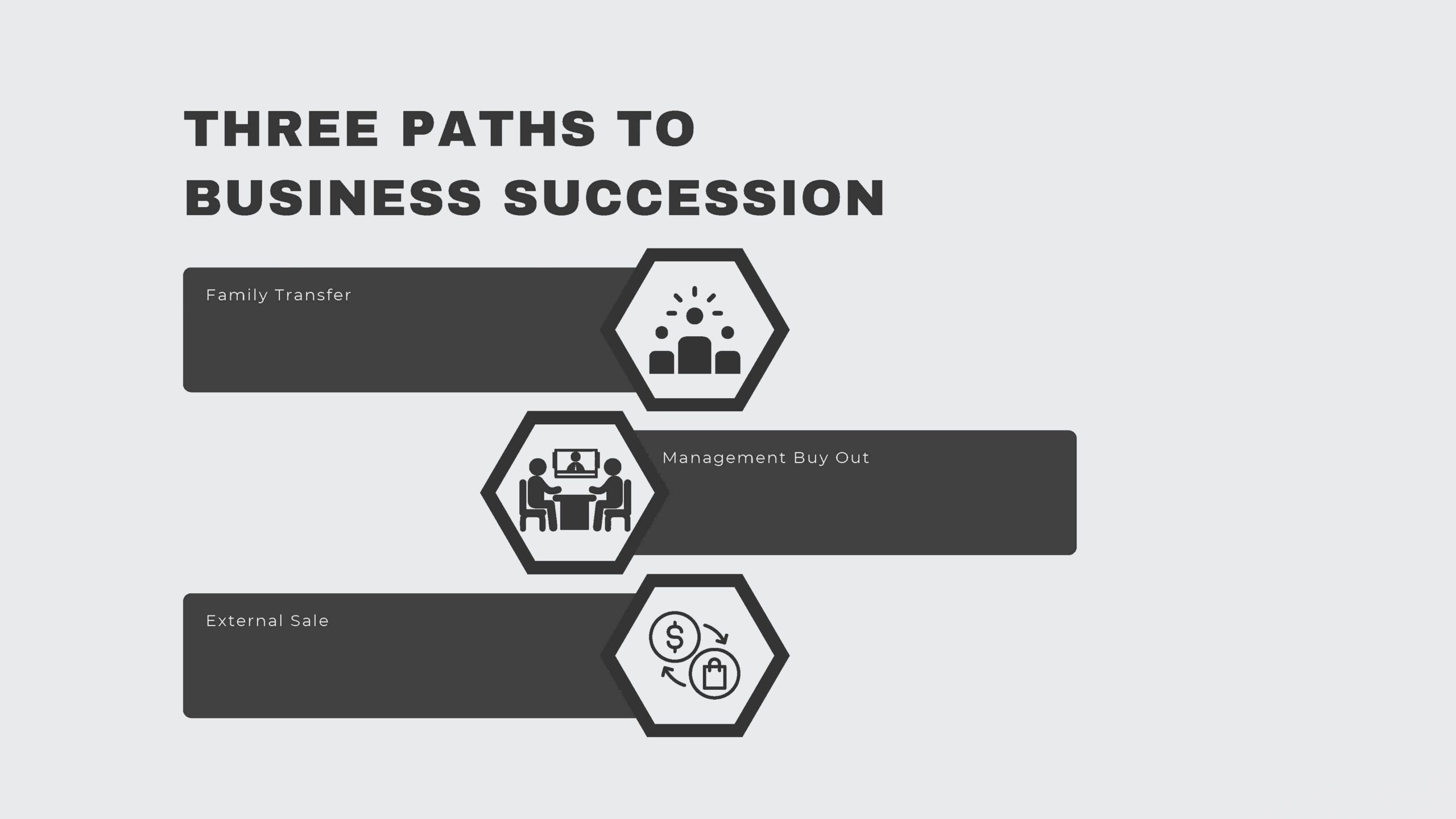
Whatever the reason, your options almost always fall into three main paths, whether it is gradual or immediate:
Each option has its own opportunities and challenges financially, emotionally, and operationally. The key is to choose intentionally, not reactively.
For many entrepreneurs, the dream is to pass the business down to the next generation.
Done well, this can preserve family legacy and reward years of hard work.
Recent changes under Bill C-208 and the 2024 Budget (Bill C-59) have made genuine family business transfers easier from a tax perspective, but only when certain conditions are met.
Planning ahead, including a gradual leadership handover and a proper valuation, is critical to success.
A successful family transition starts with open conversations, not legal documents. Begin years in advance and treat it like a business process, not a family favour.
Sometimes the best successor is already inside the building: a key employee, partner, or management team that knows the business inside and out. This approach, often called a management buyout (MBO) or employee succession, can be an elegant way to maintain continuity while rewarding loyalty.
Management buyouts often blend business strategy and personal relationships. A clear valuation, transparent communication, and strong tax structure make all the difference.
An external sale to a competitor, investor, or private equity firm, can be the cleanest path to liquidity and independence. This route is often chosen when there is no natural successor, or when the business has strong market value.
Businesses that prepare years in advance command higher valuations and smoother sales. “Sale-ready” doesn’t mean “for sale”, it means organized, compliant, and valuable.
Many businesses leave money on the table by not being prepared for a proper due diligence process and not implementing corporate structures beforehand to take advantage of significant tax savings.
You don’t need to decide today which path is right, but you do need to start preparing for all of them. The earlier you build flexibility into your structure, the more options you’ll have when the time comes.
Here’s how to think about it:
| Path | Primary Goal | Main Advantage | Biggest Risk |
| Family transition | Legacy & continuity | Keeps ownership within family | Emotional complexity; fairness issues |
| Management/employee buyout | Continuity & reward | Experienced successors, gradual transition | Financing & deal structure |
| External sale | Liquidity & independence | Maximizes value quickly | Market timing, cultural fit |
No matter which path you choose, success depends on preparation, timing, and structure.
At TAAG, we help business owners explore their options early; clarifying goals, modeling scenarios, and creating plans that protect value and reduce stress.
Because the real goal of succession planning isn’t just to exit, it’s to ensure your life’s work continues on your terms.
Issue #3 — “Building a Transferable Business: How to Get Ready for the Future.”
We’ll explore how systems, governance, and good financial practices make your business easier to transfer and more valuable when you do.

Stewart J. Spiers, CPA, CA
Associate Partner
